

1st International Conference on Built Environment – ICBE 2026
2026-05-21 15:191st International Conference on Built Environment – ICBE 2026
SUMMARY REPORT
1st International Conference on Built Environment – ICBE 2026
POLIS University, Tirana, Albania | 08 May 2026
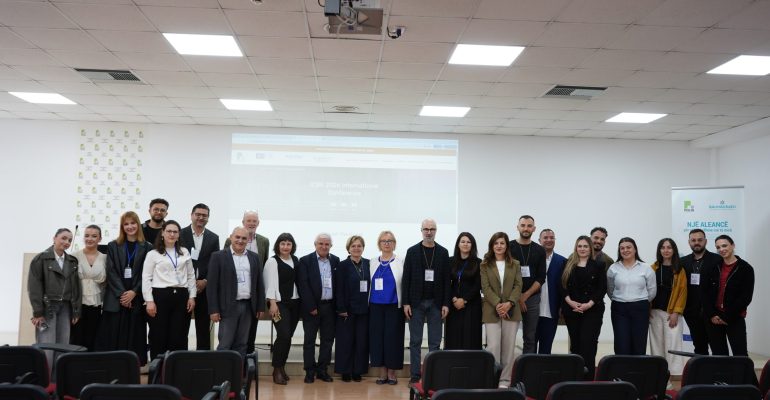
The 1st International Conference on the Built Environment (ICBE 2026), organized by the Faculty of Architecture and Design at POLIS University, brought together academics, researchers, engineers, architects, urban planners, and professionals from Albania and abroad to discuss contemporary challenges and future directions of the built environment. The conference focused on topics related to sustainability, heritage conservation, technological innovation, urban transformation, and interdisciplinary approaches to design.
The Opening Ceremony of ICBE 2026 welcomed distinguished representatives from academia, architecture, engineering, and cultural institutions, highlighting the conference’s interdisciplinary and international character. The ceremony was moderated by Dr. Klodjan Xhexhi and featured opening remarks by Dr. Ledian Bregasi, Dean of the Faculty of Architecture and Design at POLIS University, together with Prof. Dr. Rrapo Ormeni from the Academy of Sciences of Albania. The conference was also honored by the presence of Prof. Dr. Aleksandër Meksi, one of Albania’s leading scholars of architectural heritage and former Prime Minister of Albania, as well as Prof. Dr. Pirro Thomo, a distinguished scholar and expert in restoration and religious monuments. Their contributions emphasized the importance of preserving cultural identity while advancing contemporary approaches to architecture, engineering, and urban development.
The keynote lecture sessions brought together internationally recognized experts in earthquake engineering, geotechnics, architecture, urbanism, and artistic research. Prof. Dr. Svetlana Brzev from the University of British Columbia presented advanced perspectives on improving the seismic resilience of reinforced concrete frame buildings with masonry infill walls, while Prof. Dr. Markel Baballëku discussed Tirana’s seismic risk profile within the broader Albanian context. Engineer Daniel Naterop from Switzerland and Engineer Skënder Allkja shared valuable professional experience in geotechnical monitoring, risk mitigation, and structural safety for infrastructure and buildings. The conference also explored broader cultural and urban themes through presentations by Dr. Stefano Romano, focusing on art, public space, and urban diversity, and Prof. Dr. Alessandro Massarente from the University of Ferrara, who addressed ecological, infrastructural, and energy networks within contemporary urban environments. Together, the keynote speakers provided a multidisciplinary framework linking engineering resilience, technological innovation, architecture, ecology, and cultural interpretation in shaping the future of the built environment.
The scientific sessions reflected the broad and interdisciplinary nature of the conference. Session 1, chaired by Dr. Endri Duro, entitled Sustainable Materials, Resilient Construction, and Innovative Design, explored innovative construction systems, human-centered structural design, climate-responsive passive architecture, and lightweight prefabricated panel technologies. Research discussions highlighted the growing role of sustainable materials, energy efficiency, prefabrication, and resilient structural systems in contemporary construction practices.
Session 2, chaired by Dr. Seyyed Behrad Emadi and Dr. Ornela Sen, focused on Technological Advances and Seismic Design for Resilient Places. The session addressed issues related to seismic risk assessment, digital fabrication, façade transformations in prefabricated housing, and future mobility concepts for Tirana. Discussions demonstrated how digital technologies, parametric methodologies, and sustainability-oriented planning can contribute to safer and more adaptive urban environments.
The conference also devoted considerable attention to urbanism and social transformation through Session 3, Urban Planning and Social Impact, chaired by Dr. Genti Avdija. Presentations examined rapid urbanization, the loss of public space, informal architecture, urban fragmentation, and the transformation of Albanian cities such as Tirana, Durrës, and Shkodër. The studies emphasized the importance of preserving human-scale urban environments while accommodating growth and modernization.
In Session 4, chaired by Dr. Nikolla Vesho and Dr. Marsela Demaj, on Cultural Heritage, researchers discussed conservation strategies for historic buildings and sacred architecture, seismic strengthening of heritage structures, and the social implications of urban regeneration and heritage demolition. The session highlighted the need for balanced approaches that integrate conservation ethics, adaptive reuse, and structural safety within historic urban contexts.
Session 5, chaired by Dr. Francesco Scasciamacchia, explored Spaces of Connection: Art and Design for an Interspecies and Interdisciplinary Environment, presenting innovative perspectives on adaptive reuse, urban photography, spatial perception, post-industrial landscapes, digital heritage interpretation, and textile recycling. The session demonstrated how architecture, art, design, and technology can intersect to create new cultural narratives and experiences.
The final session, Pioneers of the Next Generation of the Built Environment, chaired by Dr. Flogerta Krosi, showcased emerging research by early-career researchers and students. Topics included bioclimatic kindergarten design, flood risk management in Albania, steel frame technologies, fashion design concepts inspired by architecture, and critical perspectives on objects and social space. The session underscored the growing role of interdisciplinary and experimental approaches in shaping the future built environment.
Overall, ICBE 2026 successfully established an academic and professional platform for exchanging ideas, fostering interdisciplinary collaboration, and discussing innovative solutions for resilient, sustainable, and socially responsible built environments. The conference demonstrated the increasing importance of integrating engineering, architecture, urban planning, cultural heritage, technology, and environmental awareness in addressing the complex challenges faced by contemporary cities and societies.